Designing and implementing a successful e-commerce information architecture
IBM
NUMA-Q
copyright © IBM 1999
Executive
summary
It may come as a great
surprise, but most electronic commerce enterprises are not prepared for success.
Electronic commerce (e-commerce) enterprises climb a steep information technology
ramp that must provide bullet-proof continuous availability, scalability for millions
of users, and sophisticated user-relationship-management clickstream data warehouses
in the first months of business. Ironically, a hugely successful Web site can
mean either an exploding business success or an exploding business plan, depending
on how well the e-commerce enterprise plans and executes its information technology
infrastructure.
This paper explores the common pitfalls
in the design and implementation of a successful e-commerce information architecture.
After identifying the most common problems, the paper shows how to 1) architecturally
guarantee continuous Web site availability and scalability, 2) successfully implement
a clickstream data warehouse, and 3) create a contractual environment with technology
suppliers that ensures the business success of the e-commerce enterprise. If answers
to these e-commerce information technology issues are of interest to your enterprise,
please read on...
Millions
of users on day one
Business-to-consumer
(B2C) electronic commerce enterprises are information-driven entities that have
some of the most extreme information technology solution requirements found in
the commercial business world. From the moment B2C e-commerce Web sites go online,
they must provide the functionality, capacity, and continuous availability required
for the potentially millions of users accessing Web site content. These extreme
functionality, capacity and availability requirements apply whether the enterprise
is a new e-commerce startup or the e-commerce presence of an existing brick-and-mortar
business.
But are the millions of e-commerce site
users necessarily also site customers? Obviously not梥ite users can be anyone from
casual visitors, to advertising click-throughs, to targeted prospects, to actual
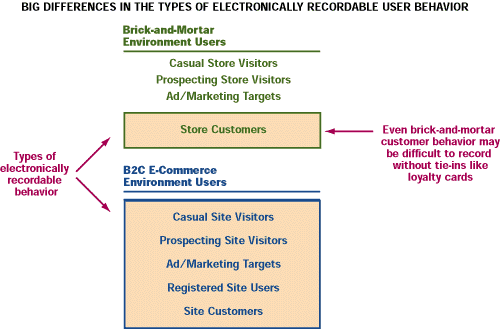
customers. While traditional brick-and-mortar commerce enterprises typically have
no easy way to record and analyze user behavior until they become customers, if
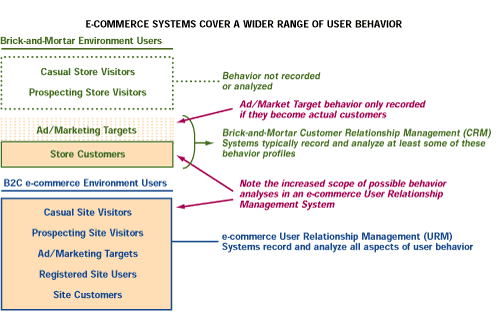
even that, e-commerce enterprises can record and analyze all activities of all
types of users, all of the time. See Figures 1 and 2.
Figure 1: Big differences in the types of electronically recordable user behavior
The ability to record and analyze all site user behavior
in minute detail gives e-commerce enterprises a significant edge over brick-and-mortar
competitors who have little direct visibility to the behavior of anyone besides
actual customers.
Figure 2: e-commerce systems cover a wider range of user behavior
The increased information processing requirements of the
information-rich Web e-commerce environment place special requirements on the
information architecture of a B2C e-commerce enterprise. These requirements and
their corresponding solution are the subject of the rest of this paper.
e-commerce
information system architecture
Electronic
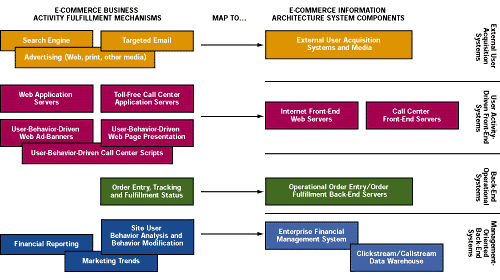
commerce enterprises typically have five categories of business activity that
are realized in up to a dozen potential business activity fulfillment mechanisms.
The correspondence between the business activities and their fulfillment mechanisms
is shown in the Figure 3. A particular e-commerce enterprise may not have a full
suite of the fulfillment mechanisms, depending on its business model and its maturity
as a business. For example, not all electronic commerce enterprises have telephone
call centers. At a minimum, they require only a Web-based customer service interface.
But a fully-functional e-commerce enterprise generally will have aspects of all
the business activities and the fulfillment mechanisms.
Figure
3: Five e-commerce business activities梞ap to梩welve potential e-commerce business
activity fulfillment mechanisms

The twelve e-commerce business activity fulfillment
mechanisms map into six information architecture system components shown in Figure
4.
Figure 4: e-commerce business activity fulfillment mechanisms梞ap to梕-commerce information architecture system components
These e-commerce information
architecture system components fall into four categories:
| External user acquisition
systems: These systems lead a customer to an e-commerce enterprise, including all advertising media Web and otherwise, Web search engines, site tie-ins, etc. | |
| User
activity-driven front-end systems: These systems include the Web content sites, the voice-based telephony call centers, and the adjunct support systems like e-mail which provide the electronic presence of an e-commerce enterprise. | |
| Back-end
operational systems: On the Web, order entry becomes a very broad category that includes much more than the ordering of products by customers. Order entry and fulfillment is the action-driven outcome of user analysis of site content, customers or otherwise. This can include product orders, information downloads, requests for more information, information tailoring requests (like My Yahoo), financial orders like stock purchase, sale, or funds transfer, general order status requests, etc. | |
| Back-end
management-oriented systems: These include financial management and reporting systems as well as a clickstream/callstream user relationship management data warehouse containing a detailed history of user activity. |
e-commerce
information system architecture stakeholders
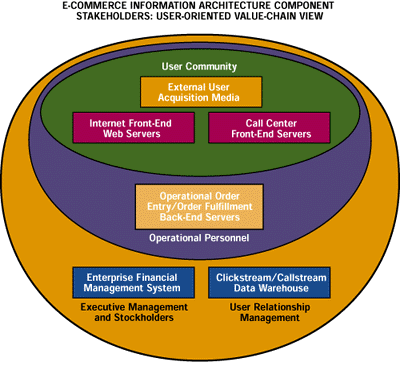
The
e-commerce information architecture components have associated cadres of interested
stakeholders, which are described below. See Figure 5. The first set of stakeholders
is the site's user community, whose attention is garnered either by external
acquisition systems, like search engines, Web ads, e-mail, or other media advertising,
or by the internal content of the site's front-end Web servers and call centers.
If the eyeball acquisition mechanisms or the site and call center fail to intrigue
or at least be useful to users, they fail these very important stakeholders. Again
we note that not all sites have call center systems, but all e-commerce sites
have Web servers by definition.
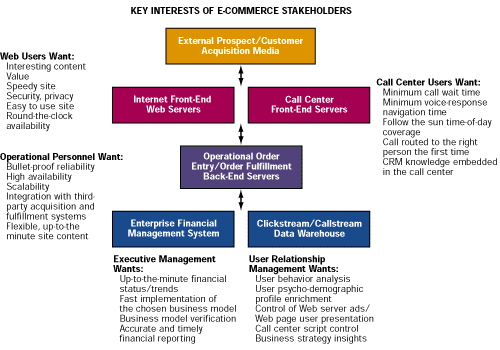
The next set of stakeholders is the e-commerce enterprise's operational personnel, who are responsible for the care and feeding of the front-end Web servers, call centers, and the operational tie-ins to external user acquisition media. In many cases, e-commerce operational personnel are solely focused on these front-end systems despite the obvious need for back-end system functionality. For more enlightened e-commerce enterprises, operational personnel also have a stake in order entry/order fulfillment systems, which centrally fulfill site-oriented activities, which may include things like user registration, requests for information, downloads, product or service (stock/auction) orders, etc. Web server site content may also be distributed centrally from such a system.
e-commerce executive management and stockholders have a stake in the success of all the systems of an enterprise, but they are acutely interested in a well implemented enterprise financial management system. These systems enable up-to-the-moment financial management of the enterprise, directly linked to the actual revenue and cost streams associated with front-end and back-end operational systems. Without such a system, management is essentially flying blind from a financial perspective, and this is very dangerous, and unfortunately a very common situation with young e-commerce enterprises. A properly-implemented enterprise financial management system can also satisfy the financial reporting requirements set forth by the SEC and investment bankers, which are among the required prerequisites for successful initial public offerings.
Figure 5: e-commerce information architecture component stakeholders: user-oriented value-chain view
While enterprise financial management is a fundamental need, the clickstream/callstream data warehouse gives user relationship management stakeholders the tools they need to make the e-commerce enterprise grow and prosper over the long term. The existence of an effective user relationship management clickstream/callstream data warehouse is one of the most important long-term success differentiators in the e-commerce business sphere. These systems record all the activity of prospects and customers, whether the contact mechanism is via the Web or a call center. Examples of captured Web clickstream information include items like the referring site, which tests the effectiveness of external media user acquisition campaigns, the Web pages visited by the site user, the time spent there, and what the user might have bought. The call center user contact records what the user did in this contact environment, either by automated voice-activated telephone scripts or by contact with human call center personnel.
This
automatically-collected treasure trove of user behavior information theoretically
gives the e-commerce enterprise a huge advantage over brick-and-mortar competitors,
who cannot easily record customer and prospect behavior. While Web server clickstream
and call center log files provide the necessary source information, the resultant
historical data warehouses can become extremely large, making them probably the
most difficult e-commerce system to implement. But once implemented these systems
affect all aspects of the enterprise and all stakeholders, including:
| User behavior analysis/trending | |
| Web site page performance | |
| Effectiveness of user acquisition strategies | |
| Effectiveness of special offers | |
| User-behavior-driven Web page presentation | |
| Presentation of Web ads according to user behavior | |
| Enrichment of user data with externally purchased psycho-demographic profiles | |
| Individualized call center script control | |
| Overall business strategy insights |
A summary
of the interests of the various e-commerce stakeholders is shown in
Figure 6.
Figure 6: Key interests of e-commerce stakeholders
The principal problem
with e-commerce information systems
So,
what is the principal problem with this complex e-commerce information architecture
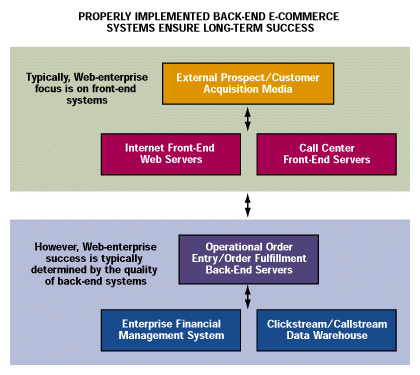
landscape? The lack of focus on back-end e-commerce information systems.
Figure 7: Properly implemented back-end
e-commerce systems ensure long-term success
Fundamental Business Problems
Many
e-commerce startups are expert-heavy in front-end Web servers and business domain
knowledge. This is good, but they often lack corresponding expertise in the details
of the back-end information systems that enable critical functions like order
entry and fulfillment, financial management, and the analysis of user behavior
on their Web sites. See Figure 7. This lack of depth in a total e-commerce IT
solution leads to the following fundamental business problems:
| The
lack of a highly available and highly scalable operational infrastructure:
Many e-commerce enterprises fail to properly construct an inherently scalable, redundant and reliable 24 x 7 x Forever Web enterprise system architecture. e-commerce enterprises must have speedy and highly available systems, including at least the Web server/call center front-end systems and the back-end order-entry and fulfillment systems. If any of the required systems are not continuously available, nor able to gracefully handle unpredictable spikes in site activity, then the user sees this immediately and the site risks the extremely negative business impact of wandering eyeballs. Wandering eyeballs lead users to competing sites that are at most a few clicks away. These wayward forays by users can lead to a permanent loss of time spent at the site. This causes a reduction in lifetime user value that can range from a significant percentage for existing users, to a potential total loss of the lifetime user value of a sales prospect or visitor who may vow to never return again. | |
| The
lack of a clickstream/callstream data warehouse: Many e-commerce enterprises fail to undertake the difficult design and implementation of a highly scalable clickstream/callstream data warehouse, which records the activities of all users of a particular Web site and its associated call centers. The knowledge derived from the analysis of the information in the clickstream/callstream data warehouse is the key to long-term competitive advantage of an e-commerce enterprise, making the implementation of an effective clickstream/callstream data warehouse an early priority in the life of an e-commerce enterprise. | |
| The alignment of
information technology vendor and e-commerce enterprise business goals:
e-commerce enterprise employees have a natural tendency to try to become e-commerce knowledge and management super-humans, attempting to orchestrate a hodge-podge of information technology vendors, including hardware, software and services, none of whom have any real stake in the success of the overall solution. Often, a better approach is to carefully choose a single overall solution vendor, with contractually guaranteed responsibility over the multiple solution component suppliers. Such an arrangement orients the responsible vendor's business interests and the success of the total e-commerce solution, with that of the e-commerce enterprise, creating natural, synergistic incentives for e-commerce enterprise success. |
It is easy
to lay blame and identify problems, but how does one construct a viable solution
model that conquers these three fundamental e-commerce enterprise dilemmas? The
next three sections explore solutions to each of these important problems.
Problem
one: a highly available and highly scalable e-commerce operational infrastructure
Because e-commerce enterprises are information entities
at their core, the problem of high availability becomes particularly acute. A
highly available implementation of the information architecture of an e-commerce
enterprise also needs to deliver high levels of performance, even in the face
of failure, which places special performance design and implementation requirements
on this highly available architecture.
Typical e-commerce enterprises take care of the first level of these requirements by sitting their Web servers at Web site-hosting service providers, like Exodus, AboveNet, Frontier GlobalCenter, and others. These site-hosting service providers typically have multiple geographically separated, secure buildings that are sited on top of central-location Internet backbone connections for fast access. The e-commerce enterprise's Web servers are placed at one or more of the Web-host service provider sites, creating fast, replicated Web server access for site users. In addition, the site-hosting service providers typically create a high availability environment for the hosted site servers, including such features as redundant Internet backbone connections, redundant uninterruptable power grids, non-water-based fire suppression, and caged-system physical security measures. An architecture diagram of this type of environment is shown in Figure 8.
Figure 8: Typical "highly available" e-commerce user site access solution, using Web site-hosting services
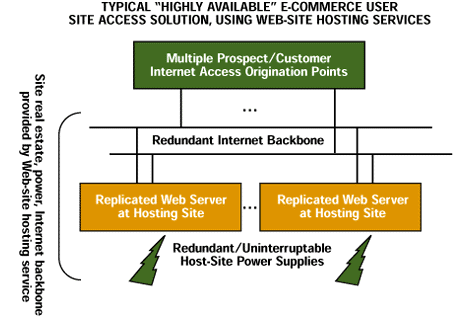
Multiple replicated-content Web servers reside at these sites, providing a continuous Web presence for the e-commerce enterprise. Users enjoy fast and reliable access, and operational personnel can theoretically sleep at night.
But not all of the critical e-commerce systems can be replicated as easily as the Web server front-ends. Back-end systems tend to be centralized by their very nature and this creates a new set of single-point-of-failure problems that go beyond the site and environmental redundancy provided by the site-hosting service provider.
For example, back-end order entry, processing and fulfillment systems are usually centralized. A customer who places an order from a particular Web server may later inquire about its status from another server, and all the order information needs to be stored in a centralized database so that this functionality can be delivered from any point of entry. But the system that houses this centralized order database becomes a major single point of failure that requires a redundant architecture on top of that provided by the Web hosting service provider.
Any failure in the hardware or software of the centralized back-end order system can stop an e-commerce site, and the types of 攐rders? can be anything from a purchase of physical goods, served-up advertisements, auction site bids, stock market buy and sell orders to site content information. These centralized information systems must have a redundant, clustered, highly available implementation within a particular site-hosting environment, or they become a single point of failure.
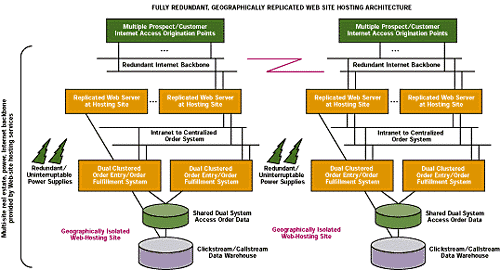
In addition to a fully redundant site-hosting architecture, it is also necessary to replicate the host site systems between at least two geographically remote locations for protection against catastrophic host site disasters, such as widespread power failures, earthquakes, storms, terrorism, and war. The replicated, multi-site strategy also enhances localized Internet site access performance, by shortening the pathway from the client to the nearest geographic server. In addition, the business model of many e-commerce enterprises causes the clickstream/callstream data warehouse to become so critical to operations that it, too, must be clustered and remotely replicated to ensure the viability of the enterprise.
Taking all of the above issues into consideration, a fully redundant, geographically replicated, high-availability e-commerce system architecture, including all front-end and back-end systems, is shown in Figure 9.
Figure 9: Fully redundant, geographically replicated Web site hosting architecture
Problem
two: the design and implementation of an effective clickstream/callstream data
warehouse
It is a cliché,
but the Web changes everything about the design of a business-to-consumer commerce-oriented
data warehouse. The wide scope of this change is best appreciated by reviewing
the typical data warehouse schema of traditional brick-and-mortar retailers, a
simple example of which is shown in Figure 10.
Figure 10: Traditional brick-and-mortar retail data warehouse
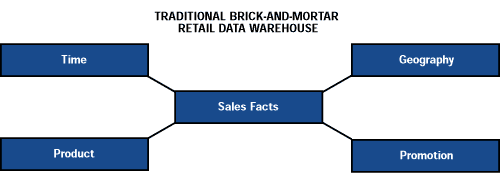
While traditional brick-and-mortar retail data warehouses differ greatly in the details of their specific implementations, all have some version of four key dimensions: Time, Product, Geography, and Promotion, as well as a Sales Fact table containing sales transaction data. Note that there is no notion of a customer dimension in this old-style data warehouse. Until recently, it was so difficult to capture the identity of a specific customer and his associated market basket that this key analytical dimension, perhaps the most important of all the dimensions, was left out. Nevertheless, the information contained in this type of schema has changed the face of retailing, greatly improving inventory management, store layout, and mass-media advertising effectiveness.
By using newer information technology customer identification techniques like loyalty cards or linkage to checking and credit card payment databases, forward-looking brick- and-mortar retailers have been able to add the Customer Dimension and associated market basket analytical capabilities to their data warehouses. This enhancement has driven the ongoing movement toward one-to-one Customer Relationship Management (CRM).
Customer/market-basket analysis is a great advance, but there are two classes of potential customer activity that are not captured by loyalty cards or other brick-and-mortar information system tie-ins. Sales prospects are potential customers that do comparison shopping at different stores, catalogs, and assess various advertisements. They move in and out of a particular retailing environment without leaving a trace of their activity, unless, of course, they actually buy and become a customer. And casual visitors, just browsing your store, catalog, or advertisements are similarly anonymous. Web-based e-commerce is unique in that it can capture all the pre-sales activity of prospecting potential customers as well as browsing visitors, greatly enhancing the enterprise's overall market knowledge, and permitting much more sophisticated customer acquisition and retention strategies. As mentioned earlier, in an e-commerce environment we lump visitors, prospects, targets, and customers into the general category of users.
Let's start with the data warehouse schema
of a forward-looking brick-and-mortar retailer and see how it changes in an electronic
commerce environment. See Figure 11.
Figure 11: Forward-looking brick-and-mortar retail data warehousing
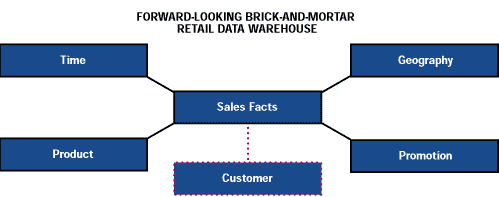
The e-commerce data warehouse site activity fact table
records much more than just sales activity.
The traditional
brick-and-mortar Sales Fact Table becomes the User Activity Fact Table in the
e-commerce environment, as shown in Figure 12. While actual sales transaction
information is all that is typically known in the brick-and-mortar world, e-commerce
sites can record all site user activity, including that of prospecting buyers,
targeted users and casual visitors.
Figure 12: The traditional sales fact table becomes the user activity fact table in the e-commerce environment
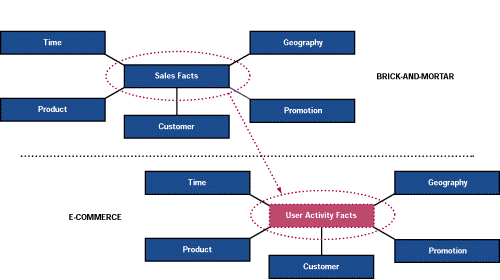
On the Web, the pre-sales activity of actual customers can be recorded in minute detail. Facts that can be recorded in a User Activity Fact Table include activity source, time spent on the activity, activity cost, and activity revenue. For example, an activity source might be a parent Web page URL, or the TCP/IP address of a site user coming into the site. Time spent is the elapsed time spent on a particular site Web page or frame. The site activity cost is the dollar cost to the enterprise for the activity on the page or frame, and the activity revenue is the revenue gained from the site activity, both of which can be any number greater than or equal to zero. Each of these site activity facts has a composite key from the associated e-commerce data warehouse dimension tables, which are explained below. The voluminous clickstream detail creates an explosion of fact table information that makes scalable data warehouse environments an absolute necessity.
e-commerce site users are more than
customers.
The leading-edge Customer Dimension
from the brick-and-mortar world becomes the User Dimension in an e-commerce environment,
as shown in Figure 13. External e-commerce site users are visitors that can be
any one of customers, prospecting potential buyers, or casual visitors, and all
their site activity is easily recorded by Web logging mechanisms. But it is important
to note that e-commerce site users do not necessarily have to be external to the
enterprise.
If customer service and call center personnel use a Web-based system, then customer service call center site activity can be recorded in the same data warehouse schema that is used for external clickstream activity. This realization is an important breakthrough, because it links all user contact activity in a single data store, whether the method of contact is via the Web or via the telephone or e-mail. All electronic user activity is recorded, regardless of media, in the unified clickstream/callstream data warehouse. And the knowledge gained from the full spectrum of user activity stored in this unified analytical model gives significant competitive market and customer knowledge advantages to e-commerce enterprises.
Figure 13: The customer dimension becomes the user dimension in an e-commerce environment
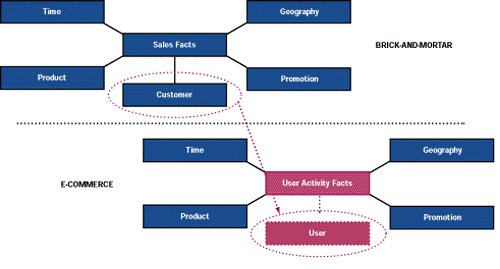
In the press and analyst reports, much is made about the difficulty of identifying a visitor to a Web site, because, at a minimum, all that is known about a visitor is his originating IP address and nothing else. While this is a problem, it pales when compared to that of the traditional brick-and-mortar retailer, who typically has no idea who visited a store (walked in and then out of his store), what they did while there, or which potential customers scanned and silently rejected expensive print or media ad-campaigns or never read them at all. In contrast, the e-commerce entity can capture the details of all client visits and Web ad-induced click-throughs, and while they may not know the client's exact identity, they at least know that he got to the site and what he did there. The analysis of his behavior is significant, even if his actual identity is unknown. This is a significant increase in customer/prospect/visitor knowledge, and it gives electronic enterprises a significant competitive advantage over brick-and-mortar competitors.
Geography gains
fine detail on the Web.
The traditional brick-and-mortar,
physically-oriented geography dimension goes virtual in e-commerce, and the result
is three new location-oriented dimensions. See Figure 14.
Figure
14: The traditional physically-oriented geography dimension goes virtual in e-commerce
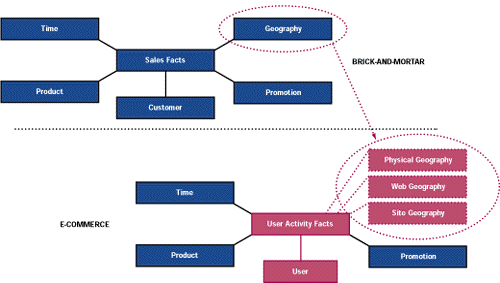
| Physical geography is the physical location of the site user. The physical geography of a user may not necessarily be derived from a user's IP address, but to the extent that it is known, it provides insight into geographic customer behavior patterns. For example, a global Web e-commerce enterprise can market summer items in July to users in the Northern hemisphere, while simultaneously marketing winter items to users in the Southern hemisphere where the seasons are reversed. | |
| Web geography is the identity of the source site which got the user to the e-commerce site. This source is at least a TCP/IP address. But source site information can be enriched with other identifying factors including Internet service provider ID, portal site ID, search engine ID, advertising server provider ID, customer service toll-free number, etc. The idea behind Web geography is to identify, as completely as possible, the mechanism used to enter the e-commerce enterprise. Identifying the location of these access origination sites is one of the keys to customer-acquisition campaign effectiveness, much like advertisements in geographical newspapers enhance sales in brick-and-mortar stores in a particular geography. Advertising efforts should be concentrated on these point-of-entry sites. | |
| Site geography is a map of the pages within a Web site, including page and frame parent information. Site geography defines the path a user takes through the content of a Web site, and the analysis of these paths is crucial to a complete knowledge of user behavior and site effectiveness. |
Time
goes individual on the Web.
Because e-commerce
enterprises have users that can be located across the globe, the traditional Time
Dimension splits into the financially-oriented Fiscal Time Dimension and a physical-geography-specific
User Time Dimension, as shown in Figure 15.
Figure 15: The traditional time dimension splits into the financially-oriented fiscal time dimension and a physical-geography-specific user time dimension
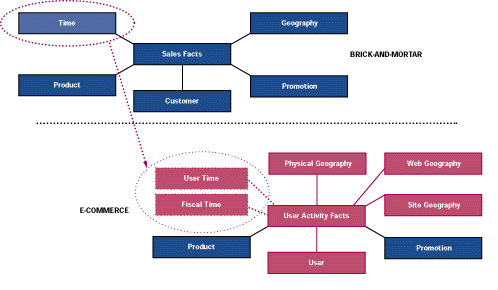
Fiscal
Time defines the fiscal year of the e-commerce enterprise, but User Time defines
the user-oriented time of day characteristics like morning, afternoon, evening,
the season of the year, etc.
e-commerce seasonality is non-intuitive without the User Time dimension. For example, Northern hemisphere users can be in User Time summer while Southern hemisphere users are simultaneously in the User Time winter season.
Content, not just
products, on the Web.
The traditional brick-and-mortar
Product Dimension changes dramatically into the content and activity dimensions
in an e-commerce environment, as shown in Figure 16. An e-commerce site's business
is defined by its content and that may include products for sale, but is rarely
exclusively so. Examples of other e-commerce offerings include interest-group
information, downloads, internal advertising, external advertising (click-throughs),
customer service, etc. All of this is described in the Content Dimension.
Figure 16: The product dimension changes
into the content and activity dimensions in e-commerce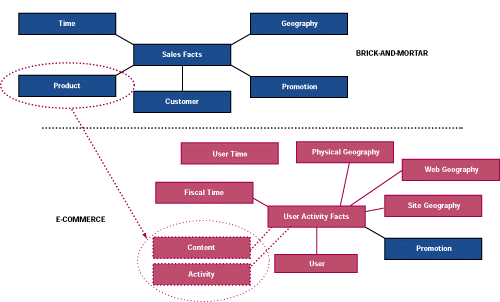
Coupled with content is the notion of Activity, which indicates what someone did in response to the content. Examples of activities include click-downs to related pages, click-throughs to external advertising, information downloads, purchases, service calls, help, etc. All of this is captured in the Activity Dimension.
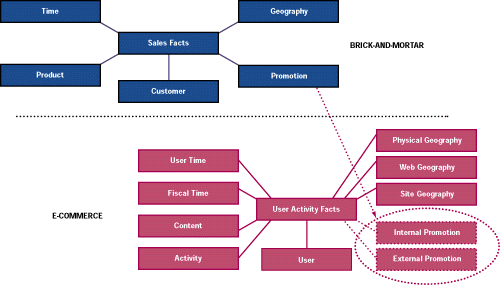
Advertising goes external on the Web.
The traditional brick-and-mortar Promotion Dimension expands
its focus beyond internally-focused advertising and sales promotions to include
externally-focused promotions on the Web, as shown in Figure 17. Most e-commerce
Web sites get revenue not only from sales, but also from external promotional
tie-ins, some almost exclusively so. While brick-and-mortar retailers advertise
brand name merchandise for sale and often get compensated for those efforts to
build an external brand, e-commerce enterprises can have external advertising
relationships which extend far beyond those found in traditional commerce.
For example, electronic ad servers serve up advertisements that are targeted at a user's behavior profile and, in return, the site receives click-through revenue based on user ad-click activity. The increased focus on external advertising revenue in e-commerce, and the different business goals of internal and external promotions, cause the single traditional pro-motion dimension to split into the Internal and External Promotion Dimensions.
Figure 17: The promotion dimensions expands to include externally-focused promotions on the Web
Another distinguishing characteristic is that Web-based
promotions are much more finely targetable than with traditional brick-and-mortar
retailers. Also, customer-acquisition media, like Internet interest sites and
chat rooms, are more finely targeted with richer media than was previously possible.
This means, for example, that a mountain climbing gear retailer may prosper on
the Web, where it might have to be part of a sporting goods chain to survive in
the brick-and-mortar world. This ability to more finely target a wider geography
and, hence, larger interest group is one of the key drivers behind the profusion
of business-to-consumer electronic commerce enterprises.
A
complete clickstream/callstream data warehouse schema.
The
end-result is the clickstream/callstream data warehouse schema shown in Figure
18. As you can see, the Web changes everything.
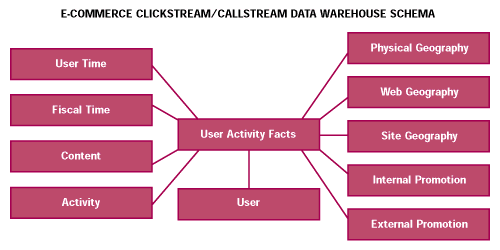
Figure
18: e-commerce clickstream/callstream data warehouse schema
Problem
three: alignment of information technology vendor and e-commerce enterprise
business goals
e-commerce solutions
have grown-up in a modern, open systems technology environment. While open systems
solutions have many advantages, they also can create fundamental business goal
alignment problems between the information technology product vendors and e-commerce
enterprise that can thwart effective e-commerce information technology solutions.
As mentioned earlier, e-commerce enterprise employees have a natural, job-performance-driven
tendency to try to become e-commerce knowledge and management Supermen, attempting
to orchestrate a hodge-podge of information technology vendors, including hardware,
software and services, none of whom have any real stake in the success of e-commerce
enterprise. This situation is illustrated in Figure 19.
Figure
19: Multi-vendor solution
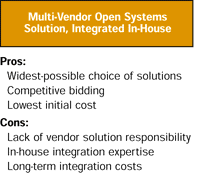
While a low cost, best-of-breed e-commerce solution, integrated by in-house personnel may seem attractive, there are several pitfalls. Unfortunately, the individual suppliers of information technology have no real stake in the success of the total e-commerce solution. They care only about their piece of it, and their economic incentive is focused primarily on the initial sale, not on long-term success of the e-commerce enterprise. The myriad of best-of-breed point-product solution vendors creates the need for deep in-house integration expertise that is vulnerable to employee knowledge, mobility and reorganization issues. Furthermore, long-term integration costs are borne solely by the e-commerce organization, and this can be an increasingly burdensome issue as time progresses, and the complexity of integration issues grow.
A natural reaction to these problems is to outsource at least a portion of the solution to a solution integrator, as shown in Figure 20.
Figure
20: Outsourced solution
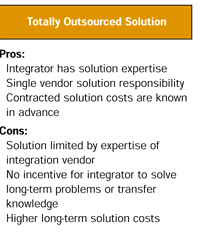
While outsourcing creates an attractive short-term management solution to the problems of an IT-lead best-of-breed e-commerce solution integration, the motivations of the outsourcer and the e-commerce enterprise are still not properly aligned. These problems surface in a number of subtle ways.
In an outsourced solution, the integration vendor is the primary provider of the solution, and they are likely the sole source of the intellectual capital for the solution. Because the contracting e-commerce enterprise is relieved of much of the responsibility for the creation of internal solution expertise, the resulting outsourced solution is limited by the knowledge, business relationships, and integration expertise of the integration vendor. These limitations can lead to long-term solution issues that cannot be easily solved by the contracting enterprise because the expertise required to do so is non-existent by definition梚t was outsourced.
This is bad enough, but the motivations of the integration vendor are rarely aligned with e-commerce enterprise business success. Most integration contracts are based on internally-focused time and materials pricing, which has nothing to do with e-commerce business success. Furthermore, there is an implicit "forever" term to outsourcing contracts, meaning that the e-commerce enterprise will pay for this external solution expertise forever, because they are abdicating the development of the same in-house solution capabilities. When coupled with the time and materials nature of integrator pricing, this can lead to an incentive for the outsourcer to never solve any fundamental business problems, because if they did, it would only reduce their revenue.
An additional worry is the practical inability to write umbrella outsourcing contracts that address all the potential information technology modifications required to support unanticipated changes in business conditions. In an Internet environment, the contract-induced inability to rapidly adjust to changing business conditions can be fatal to the enterprise.
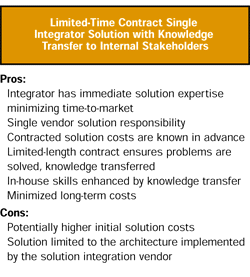
These insidious issues associated with totally outsourced solutions lead to a middle ground. While this situation is not without problems, it better aligns business goals of the e-commerce enterprise and integration solution vendor. See Figure 21. In order to solve the implied "forever" solution term with the integration vendors, the outsourcing contract must be fixed-term and non-renewable, and it must mandate sign-off criteria and specify knowledge transfer to responsible individuals in the e-commerce information technology organization. While this type of arrangement can still lead to higher initial solution costs and a solution limited by the knowledge of the integrator, the business drivers behind the motivations of both parties are much more aligned to the success of the e-commerce enterprise. The integration vendor takes time-limited and performance-goal-specific responsibility for a successful solution, and the resultant knowledge transfer causes the contracting e-commerce information technology organization to learn the skills required for long-term stewardship of the solution.
Figure 21: Fixed-term and non-renewable
outsourcing solution
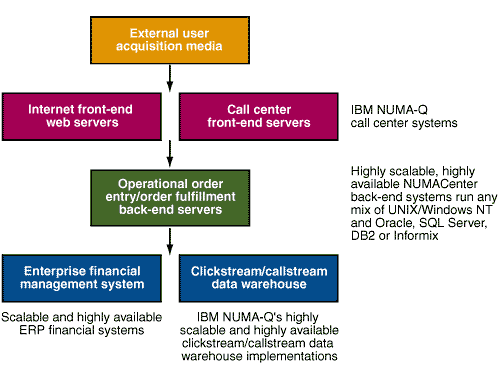
Why IBM NUMA-Q®
for your e-commerce solution?
The
answer starts by pulling apart the technical underpinnings of an e-commerce solution,
as shown in Figure 22.
Figure 22:
IBM NUMA-Q e-commerce system solutions
IBM NUMA-Q has the most scalable, available, and easy-to-manage
open systems solutions:
| Our highly scalable, Intel®-based NUMACenter? computer systems are among the most open in the industry, running Unix and Windows NT® in a single operational environment, with Fibre Channel switched fabric attached storage shared among all the operating system environments. | |
| Easy-to-manage NUMACenter systems house Unix and Windows NT systems in the same rack, all sharing the same high-performance/ highly available Fibre Channel connected storage subsystems, including EMC, Clariion, StorageTek, and others. |
IBM
NUMA-Q brings a scalable, highly available, mission-critical solution focus to
the e-commerce business environment:
| While IBM pioneering highly available hardware solutions are well known in the industry, we also provide the services required to guarantee a continuously available solution. These services cover everything from architectural design services to long-term, single-source-of-responsibility solution support. | |
| Take advantage of IBM's scalable and highly available e-commerce solutions and avoid the slow performance and site downtime headlines experienced by other prominent e-commerce enterprises and the resulting negative financial impacts. |
IBM NUMA-Q has the design, implementation, and
solution integration expertise required for all the critical back-end systems
that are the key to the long-term success of an e-commerce enterprise:
| IBM NUMA-Q's award-winning professional services can design and implement your electronic commerce solution, including critical order entry and financial systems as well as a clickstream/callstream data warehouse. | |
| IBM will take sole-source responsibility for the success of your electronic commerce application and infrastructure, including all of the hardware, software and services-that means everything, no solution gaps, no vendor finger-pointing. |
IBM provides, as an explicit deliverable, knowledge
transfer:
| IBM's combined product and services revenue stream creates a business model that rewards the completion of the maximum number of e-commerce solutions in the shortest time possible. The need to move on to newly contracted solutions creates incentive for effective knowledge transfer to the responsible IT organization. |
IBM provides the fastest route to a solution:
| Because IBM has NUMA-Q hardware, software and services required to sole-source an e-commerce solution, we are typically the fastest route to a complete e-commerce implementation. You can piece together your own e-commerce solution, or you can chose IBM NUMA-Q and concentrate your resources on the higher-value areas of your business. |
&
| 利用数据库营销赢得新顾客 2002-01-30 |
| 吸引目标消费者的工具——邮件营销 2002-01-30 |
| 企业的客户关系管理 2002-01-30 |
| 建立CRM数据库的几个原则 2002-01-30 |
| 客户关系管理简介(中英文对照) 2002-01-30 |